Galerie Vivienne
Paris
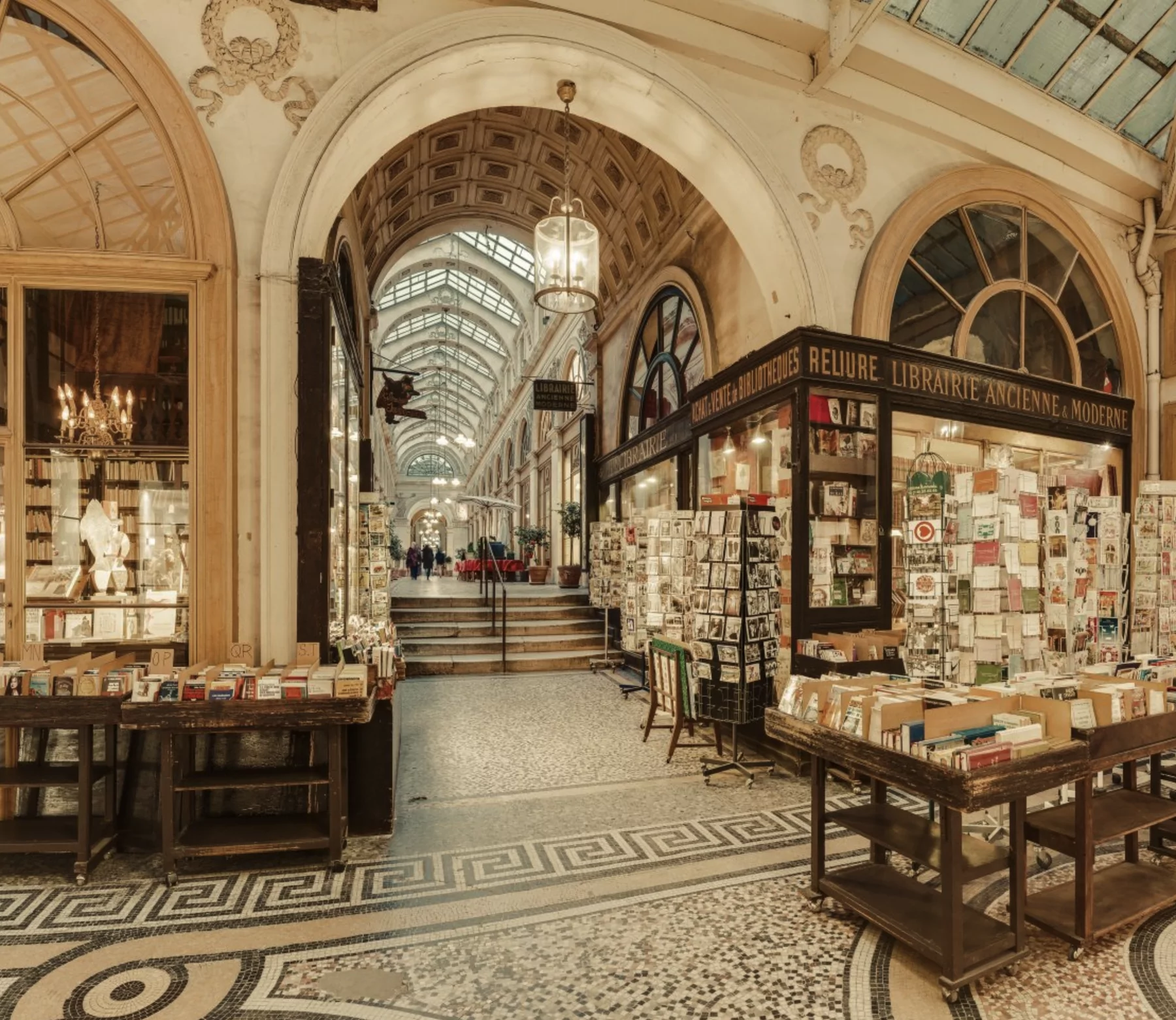
Formerly Galerie Marchoux, it is a covered passage stretching 176 meters in length and 3 meters wide. It connects Rue Vivienne, Rue des Petits-Champs, and Rue de la Banque.
Built in 1823 by Louis-Auguste Marchoux, president of the Chamber of Notaries, it was designed by architect François-Jacques Delannoy in a Pompeian neoclassical style: elegant stained glass, mosaics, paintings, and sculptures celebrating commerce. The floor mosaics are signed Giandomenico Facchina, and a glazed rotunda topped with a hemispherical dome extends the main gallery. Originally named "Marchoux," it was renamed "Vivienne" in 1825.
Thanks to its strategic location between the boulevards and the business district, it attracts tailors, booksellers, opticians, and confectioners, becoming one of Paris's most frequented passages despite a low ceiling criticized by some contemporaries. Bequeathed in 1859 by sculptress Ermance Marchoux to the Institut de France to fund the Prix de Rome, the gallery experienced its golden age until the end of the Second Empire, before suffering from Haussmannian transformations.
It houses the former residence of Vidocq and, as early as 1880, the future Legrand cellars. Facing crisis in the 1960s, it was saved by artist Huguette Spengler and revitalized in 1986 thanks to installations by Jean-Paul Gaultier and Yuki Torii — Kenzō Takada also opened his first boutique there. A controversial renovation in 2016 sparked debate. Since 2018, it has been twinned with the Royal Saint-Hubert Galleries in Brussels.
All exhibitions and places in and around Paris on Groom