Grande Mosquée de Paris
Paris
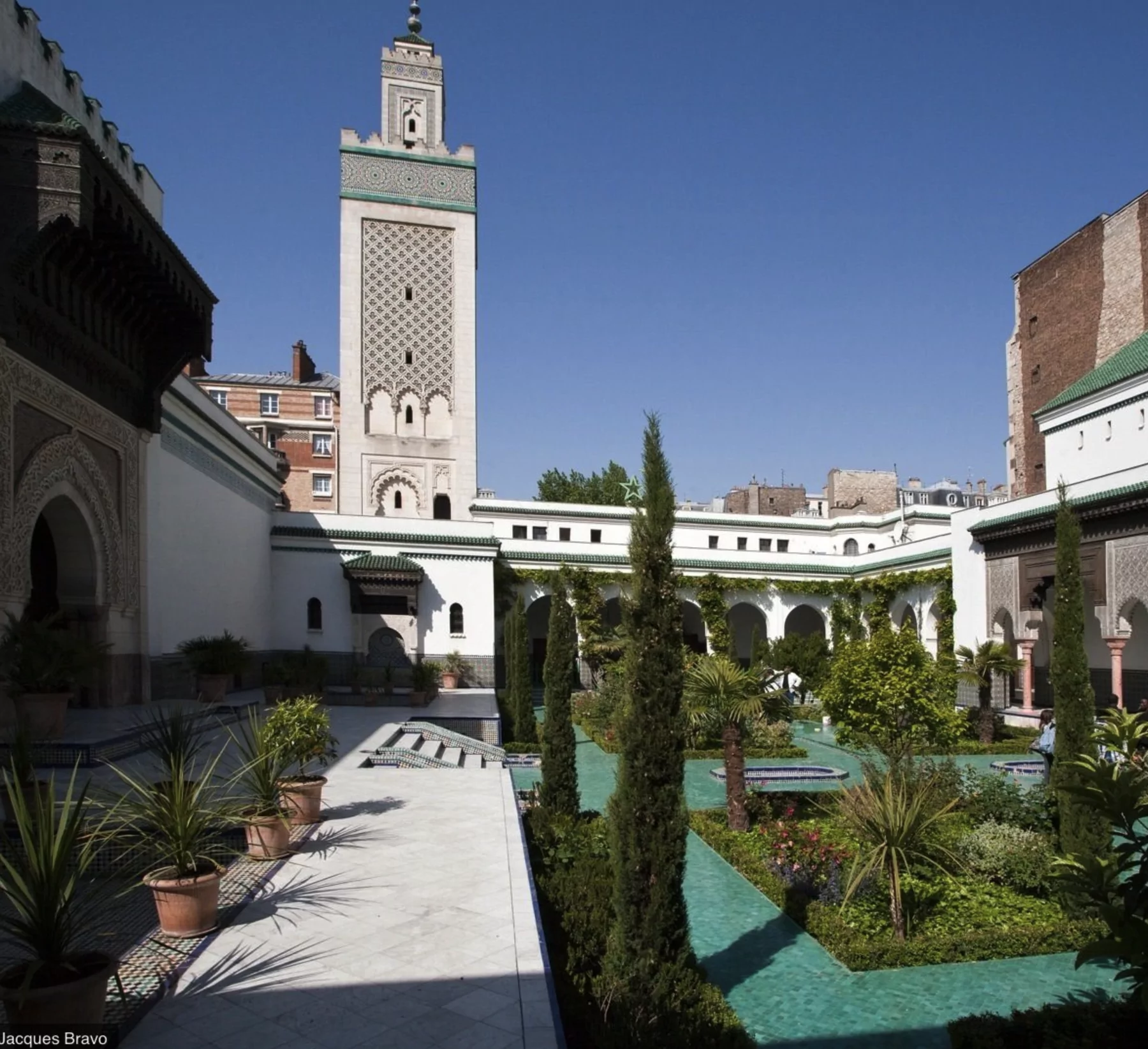
A Hispano-Moorish style building featuring a 33-meter minaret. It is the oldest active mosque in metropolitan France, inaugurated in 1926, and can accommodate up to 1,000 worshippers on a site of 7,500 m².
Its history is closely tied to French colonialism: the project was conceived as a tribute to Muslim indigenous soldiers who died in World War I. Construction was funded by the State through a 1920 law granting a subsidy of 500,000 francs; however, to circumvent the Law on Separation of Churches and State, it is the Society for Endowments (Habous) and Holy Places of Islam, founded in Algiers, that officially bears the project. The mosque draws inspiration from Al Quaraouiyine University in Fès and Almohad art, featuring zellige work executed by Moroccan artisans.
During World War II, according to several testimonies, the mosque allegedly served as a refuge for resistance fighters and hundreds of Jews, notably through the issuance of forged Muslim identity certificates, although estimates of the number of people saved vary significantly depending on the source.
Today, the institution remains religiously and culturally tied to Algeria, whose opinion carries weight in the appointment of its rector—currently Chems-Eddine Hafiz. It plays a central role in Islam in France (Halal certification, imam training) while regularly finding itself at the heart of geopolitical tensions, particularly between Algeria and Morocco.
All exhibitions and places in and around Paris on Groom