Hôtel de la Païva
Paris
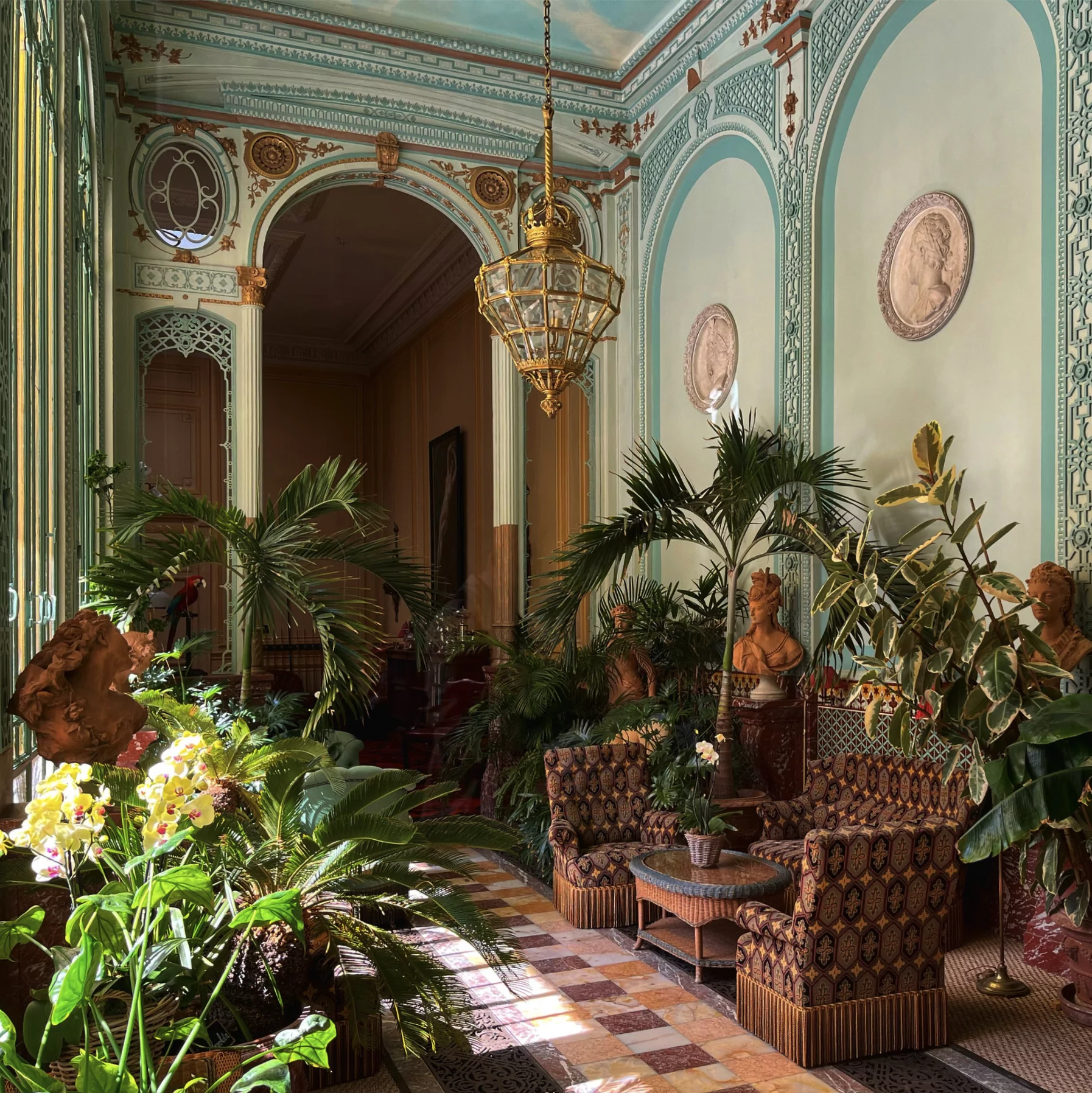
Esther Lachman, born in 1819 into a very modest family, became the Portuguese Marchioness and later the Prussian Countess through her marriage to Bismarck's cousin. Between 1856 and 1865, she commissioned architect Pierre Manguin to build this hotel. Legend has it that after being pushed out of a carriage at this spot, she vowed to construct "the most beautiful house in Paris." The construction took nearly ten years and cost ten million gold francs.
The style is that of the Italian Renaissance, featuring a suspended garden, and Manguin surrounded himself with the finest sculptors of the time: Barrias, Cugnot, Delaplanche, Legrain, Carrier-Belleuse, and Dalou. Two distinct carriage entrances—one for the entry of carriages, the other for their exit—prevented them from crossing paths in the courtyard.
The staircase is made of yellow onyx, a rare material extracted from a Roman quarry rediscovered near Oran in 1849 and later becoming the signature of Second Empire luxury. It is accompanied by a monumental bronze lamp post and statues of Dante, Petrarch, and Virgil. The Moorish-style bathroom, clad in faience tiles by Théodore Deck, retains a bathtub carved from a single block of onyx weighing 900 kilograms, lined with silvered bronze, whose gilded faucets are set with six turquoise stones. The ceiling of the grand salon, "Day Pursuing Night," is by Paul Baudry. The Goncourts, who received it in 1867, summarized the place with a famous formula: "the Louvre du cul."
All exhibitions and places in and around Paris on Groom