Mémorial du Mont-Valérien
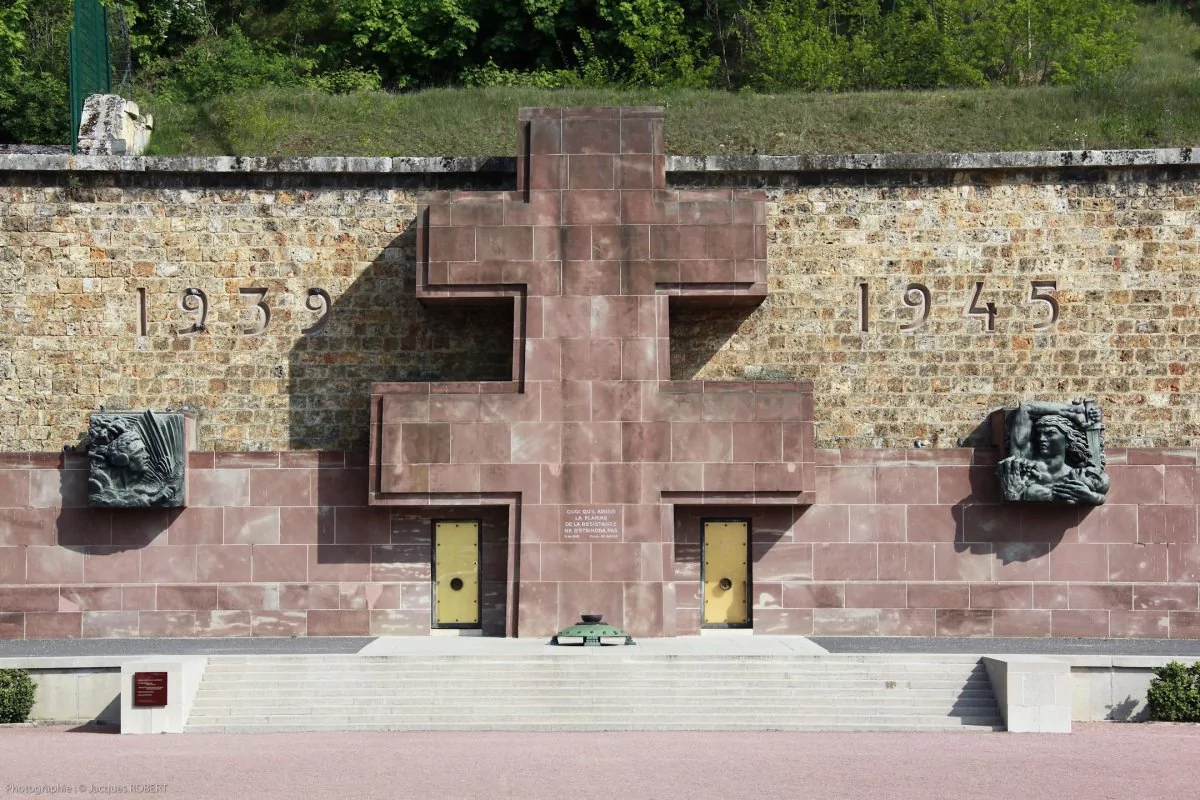
During the Occupation, the fortress overlooking the hill served as an execution site: more than a thousand resistance fighters and hostages were shot there, including Honoré d'Estienne d'Orves and the twenty-two members of the Manouchian group. As early as June 18, 1946, de Gaulle paid tribute to those executed; in November of that same year, fifteen bodies were interred in a temporary crypt.
The selection of the remains gives meaning to this place. Henri Frenay transposes the idea of The Unknown Soldier into a war that encompassed no single type: each category of combatant — soldiers of 1940, Free Frenchmen, internal resistance fighters, deportees, prisoners, men of the Empire — is represented by one of their own. Among them are two women, Berty Albrecht and Renée Lévy; Senegalese tirailleurs, Moroccan and Tunisian tirailleurs, an Indochinese resister. The seventeenth vault, long left empty, received in November 2021 Hubert Germain, the last companion of Liberation.
Upon returning to power, in 1958 General de Gaulle commissioned architect Félix Brunau to erect a definitive monument, inaugurated on June 18, 1960. A wall of pink Vosges sandstone, stretching 150 meters long, abuts the meulière rampart of the fortress, enclosing an esplanade exceeding one thousand square meters. At its center stands a twelve-meter-high Lorraine cross marking the entrance to the crypt, before which burns a perpetual flame. Sixteen bronze high reliefs, arranged like metopes, depict the forms of struggle for Liberation. A memorial path then leads through the military enclosure to the clearing where executions took place.
All exhibitions and places in and around Paris on Groom