Le Centre Pompidou
Paris
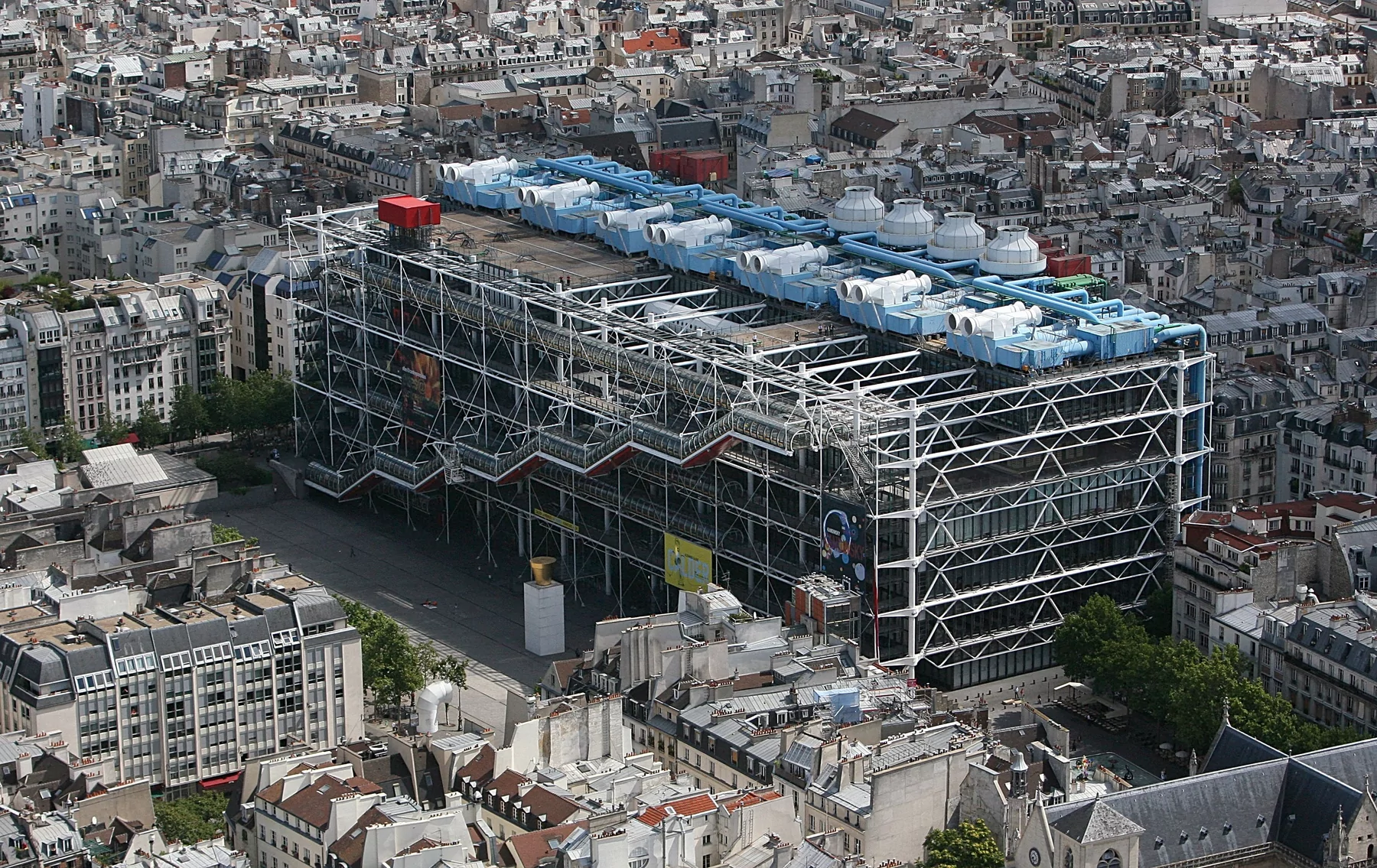
Launched in 1969 by President Georges Pompidou, this project aimed to create a cultural center in Paris bringing together modern art, a public library, and musical creation. An international architectural competition was held in 1971; approximately 700 projects were submitted. The team comprising Renzo Piano, Richard Rogers, and Gianfranco Franchini was selected.
Construction spanning from 1972 to 1977 on the site of the Beaubourg plateau, then an urban wasteland. The building opened to the public on January 31, 1977. Its architecture elicited contrasting reactions at the time; some critics deemed it poorly compatible with the surrounding urban fabric.
The chosen architectural principle involves placing typically concealed technical elements outside the building: structural framework, ventilation ducts, electrical networks, and circulation systems (escalators, walkways). This approach allows for creating large, column-free exhibition spaces inside that can be reconfigured according to exhibition needs. The exterior technical elements are painted using a color code: blue for air, green for water, yellow for electricity, and red for pedestrian circulation. This type of approach is associated with the architectural movement known as "high-tech."
The building houses the Musée national d'art moderne, whose collection includes works by Matisse, Picasso, Kandinsky, and Duchamp, as well as a public information library and the IRCAM, music research center.
All exhibitions and places in and around Paris on Groom