Église Notre-Dame de la Consolation
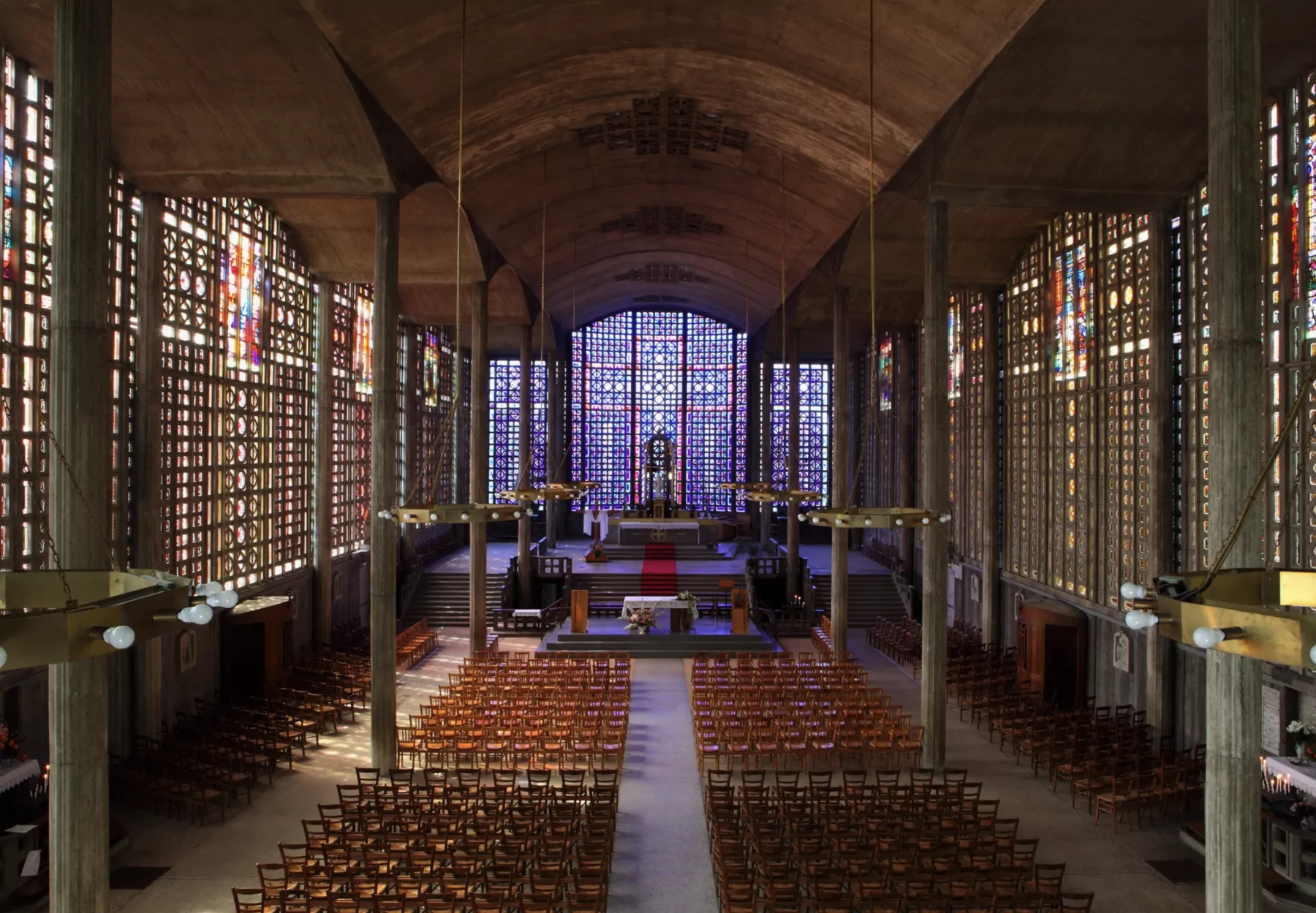
Abbé Félix Nègre sought, as early as 1918, a church to commemorate the victory at Ourcq and the city from which departed one of the Marne's taxi columns — hence the dedication Notre-Dame-de-la-Consolation, an iconography that would be rendered in the stained glass. In 1922, subscriptions raised only 330,000 francs when the lowest estimate submitted to date stood at 1,800,000. Auguste Perret — atheist architect, son of a communard who dreamed of building a church — proposed that this sum suffice. The parishioners feared their would become "a hangar." The cornerstone was laid on April 30, 1922; the edifice was consecrated fourteen months later.
This is the first reinforced concrete church in France. The program remains traditional — basilican plan, bell-tower porch, Gothic inspiration — but its execution does not: thin fabric walls for the nave and aisles, exposed concrete, and an extensive standardization of modular elements and their assembly, which accounts for both the speed and cost of construction.
The rectangular plan is divided into three naves, striking a balance between the hall-church formula and that of the basilica. The walls are replaced by cast concrete cloisters set with stained glass windows, supported by slender columns: these chromatic variations within an open tracery have earned the site its nickname, "Sainte-Chapelle in reinforced concrete."
Concrete alterations were noted as early as the 1960s. The roofs were restored in 1988–1989, the bell tower in 1991, and the facades between 1992 and 1996, featuring new resin concrete claustras with stainless steel reinforcement. Listed as a historic monument since 1966.
All exhibitions and places in and around Paris on Groom