Panthéon
Paris
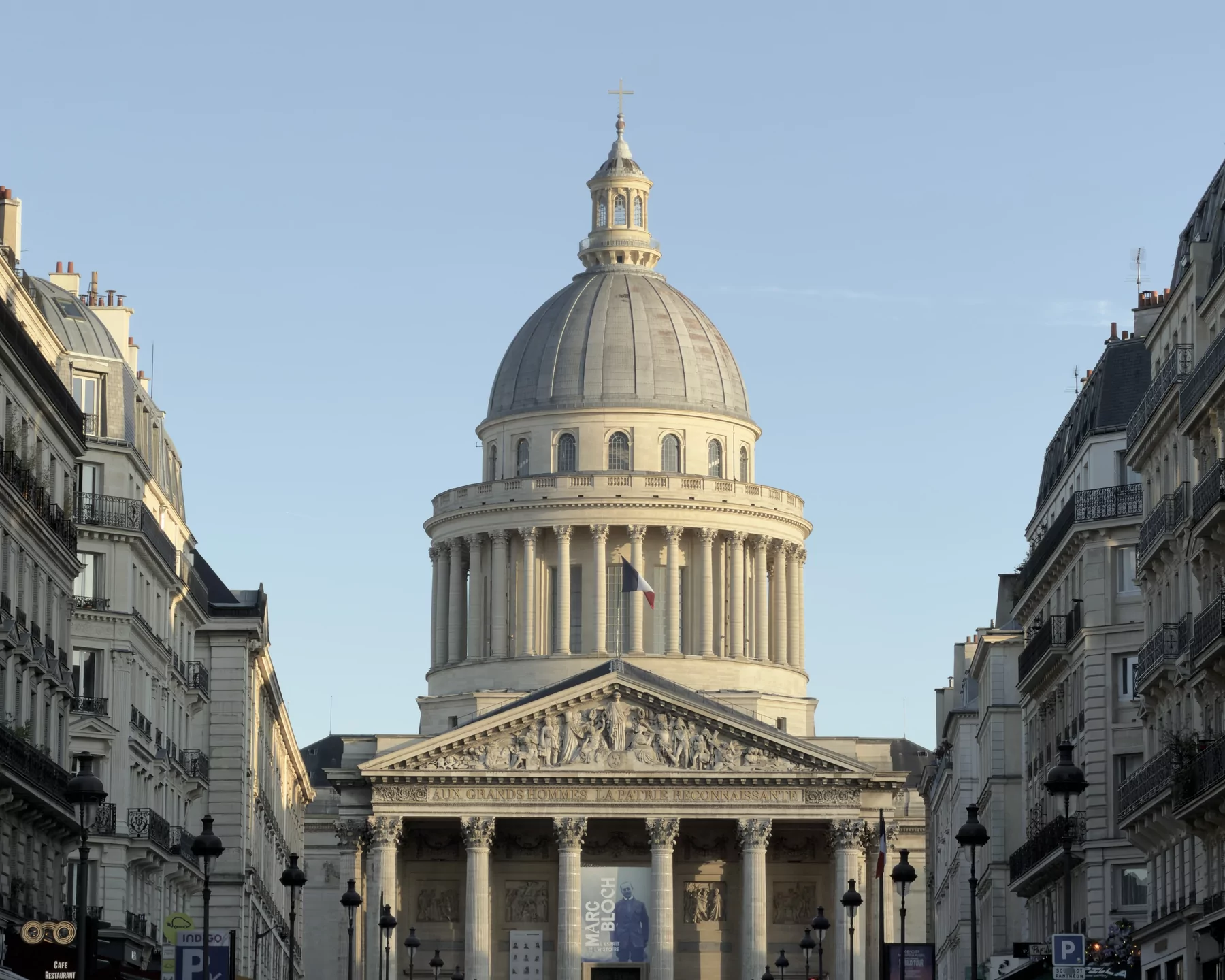
Its construction was decided by Louis XV, who wished to build a church dedicated to Saint Geneviève, patron saint of Paris, intended to house her relics and replace an older sanctuary located on the same site. The works, entrusted to architect Jacques-Germain Soufflot, began in 1758. Soufflot died in 1780 without seeing the building completed; his student Jean-Baptiste Rondelet continued and finished the construction in 1790.
The building exemplifies the Neoclassical style, as Soufflot sought to reconcile the structural lightness of Gothic cathedrals with the compositional principles of ancient architecture. The structure follows a Greek cross plan, crowned by an imposing dome at the crossing of the transept, while four lower domes cap the arms of the building, concealed beneath a sloping roof. The main façade revives the model of Rome's Pantheon, featuring a portico of Corinthian columns supporting a triangular pediment.
Completed at the time of the French Revolution, the building was transformed in 1791 by the Constituent Assembly into a necropolis intended to receive the remains of great men of the nation. It alternated between religious use and mausoleum function several times during the nineteenth century, before being definitively dedicated to this latter purpose in 1881 under the Third Republic. Certain openings were then walled up to give the interior a darker, more funerary atmosphere, partially altering Soufflot's original luminous design.
All exhibitions and places in and around Paris on Groom