Jardin des Serres d'Auteuil
Paris
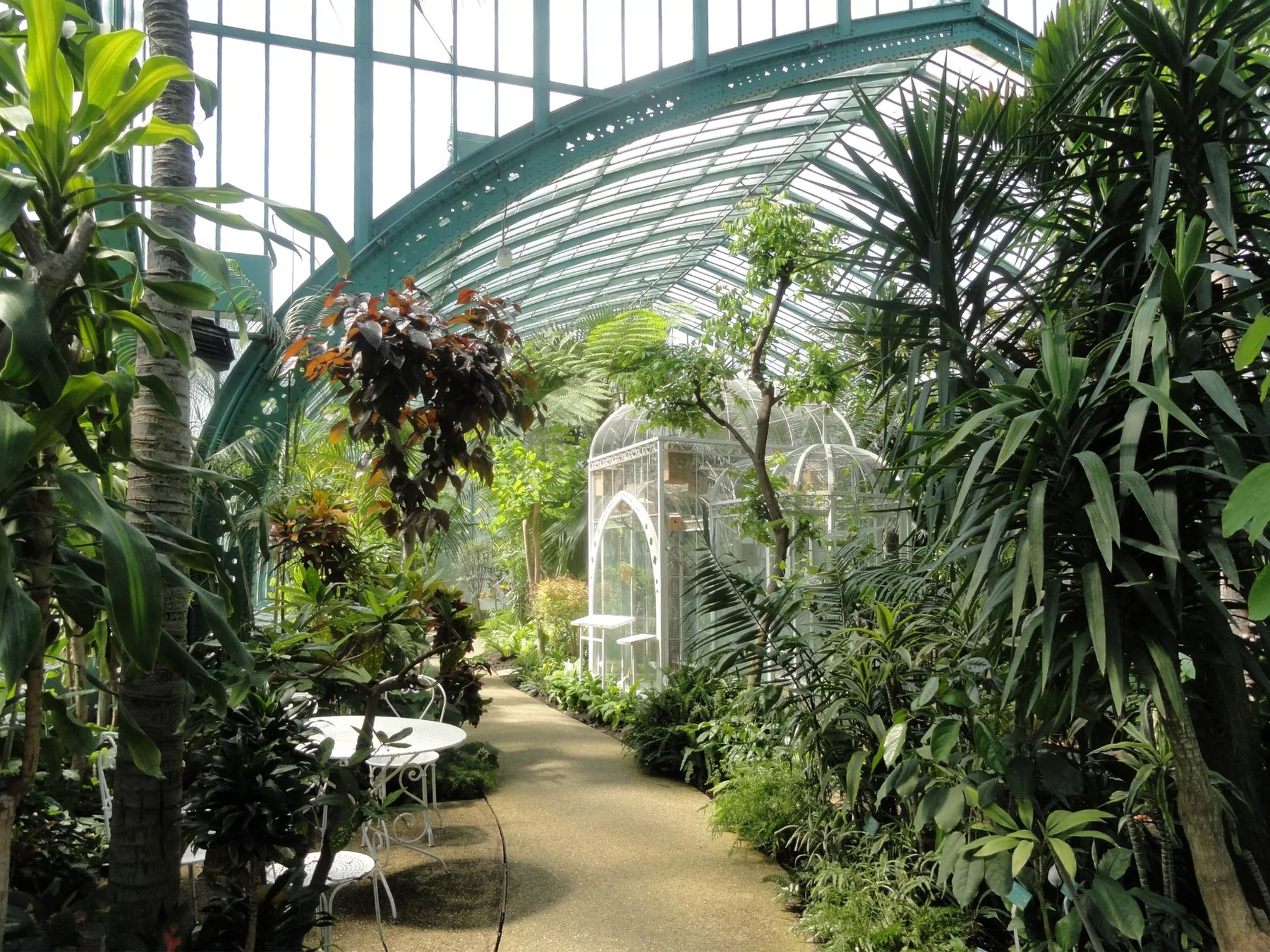
The first botanical garden with greenhouses was established in 1761 for Louis XV at rue d'Auteuil, next to his Château du Coq; it was sold by Louis XVI to Joly de Fleury in 1778 and fragmented a century later. In 1855, engineer Adolphe Alphand created further north the city of Paris's flower garden, which then comprised more than thirty greenhouses and produced three million seedlings annually; it was transferred to Auteuil in 1898.
Jean Camille Formigé, chief architect of the Promenades and Plantations service, was commissioned to create a new horticultural production facility for Paris's green spaces; construction took place from 1895 to 1898. The garden is organized around a large French-style parterre upon which five main glasshouses with blue-green painted iron frameworks are situated, forming pointed arches. The great greenhouse divides its nave into three distinct climatic zones: humid tropical garden, drier palm grove, and less warm orangery. Also included are the Bacchanale fountain sculpted by Jules Dalou and fourteen galvanized-iron mascarons by Rodin, cast from models commissioned in 1878 for the Trocadéro Palace.
The garden houses nearly five thousand plant species: 580 begonia taxa, 515 orchids, 400 bromeliads, as well as plants from the Sahel and New Caledonia. Among its notable trees are a ginkgo biloba and a Pterocarya stenoptera, which is the tallest in the garden.
In 1968, the Auteuil interchange and the outer ring road eliminated one-third of its surface area. Inscribed on the list of historic monuments in 1998, the site became from 2011 the focus of a conflict over the extension of Roland-Garros Stadium, pitting the French Tennis Federation and Paris City Hall against environmental and heritage associations. Despite an injunction obtained by Formigé's heirs invoking moral rights, the glasshouses were destroyed in 2016.
All exhibitions and places in and around Paris on Groom