Maison La Roche
Paris
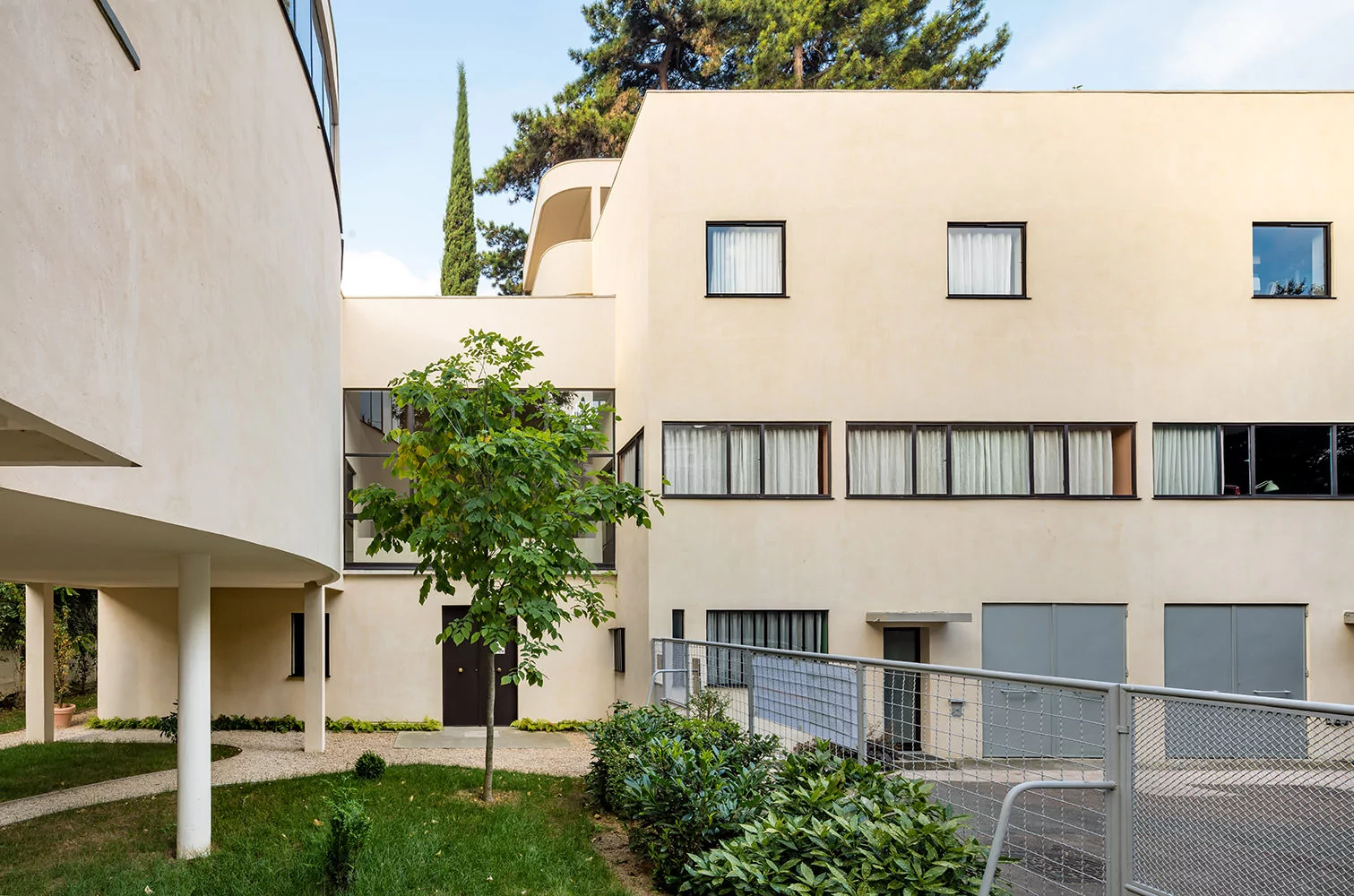
The Basel collector Raoul La Roche moved to Paris in 1912, met Le Corbusier in 1918, and assembled a collection of Picasso, Braque, Léger, and Lipchitz on their advice—along with that of Ozenfant. "When you have a fine collection like yours," he said, "you must build a house worthy of it." The villa was constructed between 1923 and 1925 by Le Corbusier and his cousin Pierre Jeanneret at the end of a cul-de-sac, paired with a second residence intended for the architect's brother.
It is here that the five points of a new architecture find their first built expression, and above all where the idea of an architectural promenade takes birth: "One sees the ordinances of architecture develop by walking, by moving." The two functions are dissociated—housing on one side, gallery on the other, both raised on stilts along the axis of the plot—and a double-height hall distributes two independent circuits connected to the upper floor via a bridge.
The gallery stretches horizontally in contrast to the vertical atrium; a ramp nestles into the curve of the facade and ascends toward the library, which is illuminated directly by an arched window and indirectly by the void of the hall. The room, known as "La Puriste," barely accommodates a bed. On the roof lies a garden with a gazebo and benches.
The furniture was entirely designed or selected by the architects; in 1928, the gallery was renovated with Charlotte Perriand. Classified in 1996, the house has been listed as a World Heritage Site since 2016.
All exhibitions and places in and around Paris on Groom