Passage des Panoramas
Paris
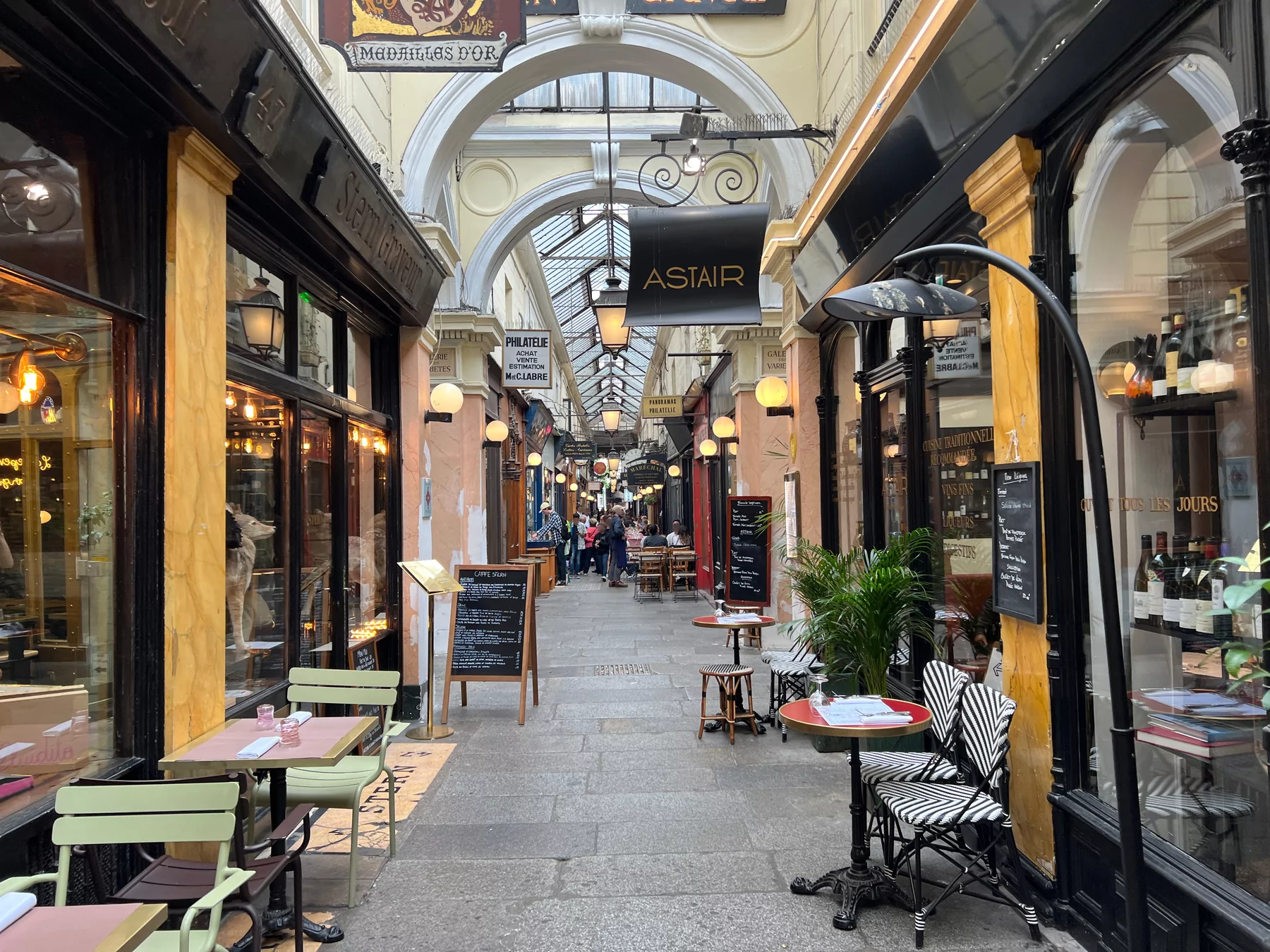
A covered passageway connecting Boulevard Montmartre to Rue Saint-Marc. Built in 1799 by Jean-Louis Girard, it is, along with the Caire Passage, one of Paris's oldest covered passageways and one of Europe's first commercial covered passages.
Its name derives from an attraction installed at the entrance by American engineer Robert Fulton: two rotundas displaying panoramic views of famous cities, funded in anticipation of Napoleon's response to his projects for steamships and submarines. After the acquisition of the site by shipowner James William Thayer, the first section of the passage was excavated and named "Panoramas" in memory of these rotundas, which were destroyed in 1831.
The passage innovated with its glass-roofed walkways, and in 1816 with the first gas lighting experiment by Philippe Lebon, becoming a precursor to modern commercial galleries. In 1834, architect Grisart renovated it and added several annexed galleries (Saint-Marc, des Variétés, Feydeau, Montmartre). Throughout the 19th century, it hosted luxury shops, including the engraver Stern's boutique (now Caffè Stern), the bust museum of sculptor Dantan, and later the Académie Julian, one of the few places open to women for studying the arts.
The Passage also marked literature: Émile Zola describes it in Chapter VII of Nana, and Anne Cuneo dedicated an eponymous novel to it in 1978. It allegedly even inspired a shopping gallery in Budapest.
All exhibitions and places in and around Paris on Groom