Jardin d'agronomie tropicale
Paris
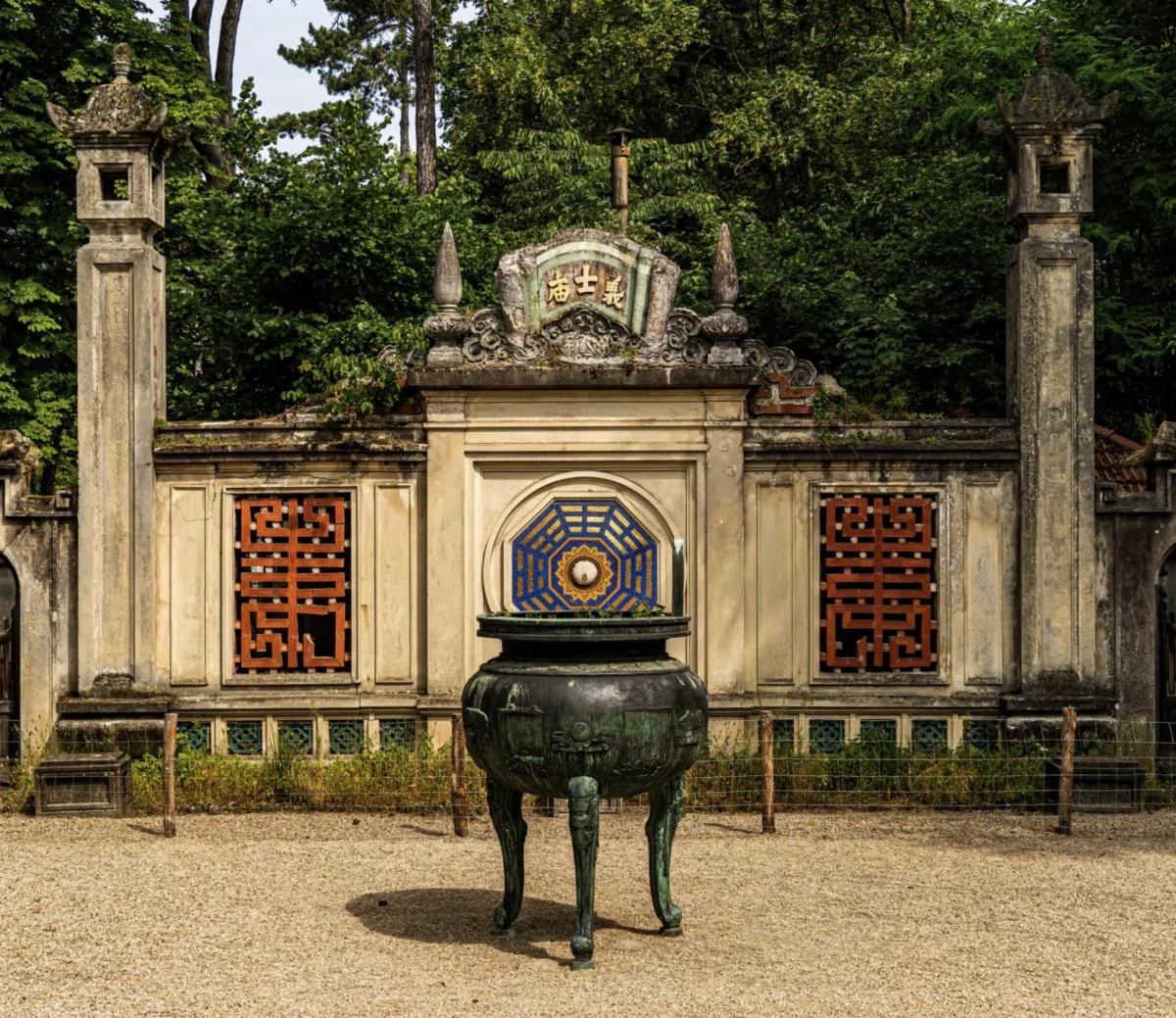
Created in 1899 under the name "colonial experimental garden," it was designed as a laboratory to experiment with the cultivation of tropical and exotic plants in order to develop agriculture in French colonies.
In 1907, the site hosted the Colonial Exposition, which recreated several villages representing various French colonies and protectorates, including Indochina, the Congo, Madagascar, Tunisia, and Sudan. This event, which attracted up to two million visitors, staged populations from these territories in reconstructed habitats—a practice now analyzed as akin to "human zoos" and widely criticized for its dehumanizing nature.
Architecturally, the garden preserves a heterogeneous collection of pavilions and structures evoking the represented regions: a Chinese gate, a Khmer bridge, a Tonkin bridge, as well as pavilions dedicated to Morocco, Guyana, Réunion, and Tunisia—the latter having undergone recent restoration. An Indochinese memorial temple and several commemorative monuments, notably honoring colonial soldiers who died for France, complete the ensemble.
Following the exhibition, the site became an agricultural research center before experiencing long-term abandonment throughout most of the 20th century. Owned by the City of Paris, it was partially restored and reopened to the public in the mid-2000s, deliberately preserving the ruinous appearance of many structures, which are now regarded as a heritage testimony of French colonial history.
All exhibitions and places in and around Paris on Groom