Centre Culturel Irlandais & Chapelle
Paris
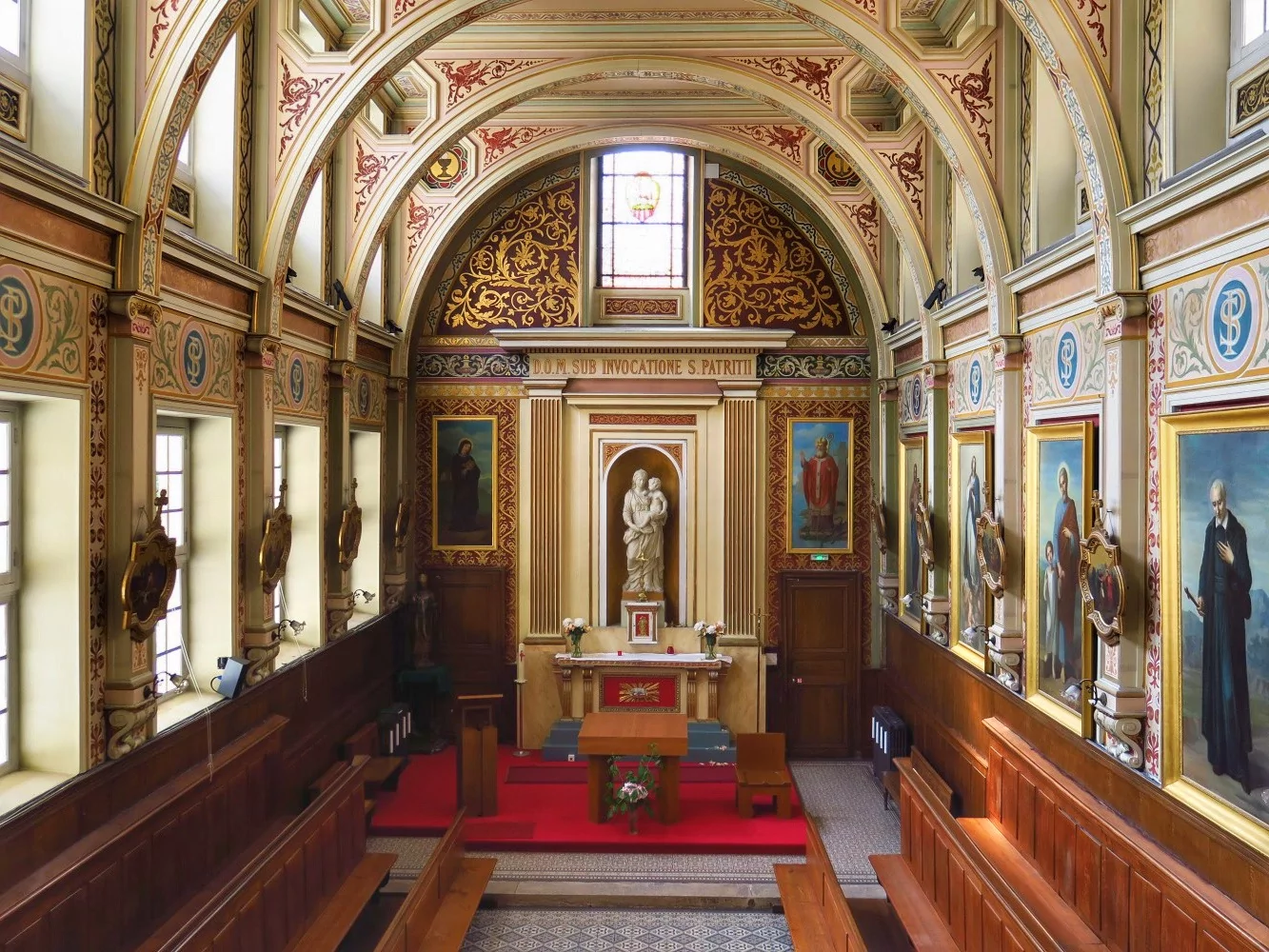
Religious persecutions under Queen Elizabeth I and King James I closed the monastic schools in Ireland, forcing the clergy to train abroad: Irish colleges opened in Rome, Spain, Portugal, Belgium, and France. The Paris college was founded around 1605 by priest John Lee, who arrived there in 1578 with six companions; a president of the Parliament of Paris lent them a house. In 1623, Louis XIII granted Irish clergy the right to own property; the University of Paris recognized the college as a seminary in 1624, and Louis XIV provided it its first permanent residence in 1677 at the College of Lombards.
The current building dates from 1769, when Prefect Laurence Kelly acquired a townhouse and its grounds in the former Rue du Cheval-Vert. François-Joseph Bélanger renovated and expanded it in 1775 around a sober classical courtyard featuring a chapel and library.
The site then traversed all regimes: transformed into shops during the Revolution, returned to the seminary under the Restoration, converted into a hospital for three hundred French wounded during the War of 1870, and used as shelter for displaced persons in 1945. The Polish Seminary in Paris occupied it from 1945 to 1997.
Restored in 1989, they have housed since 2002 a cultural center that reopened the chapel and vaulted rooms to contemporary creation: exhibitions, concerts, artist residencies, alongside an ancient collection of several thousand volumes.
All exhibitions and places in and around Paris on Groom