Les Étoiles d'Ivry
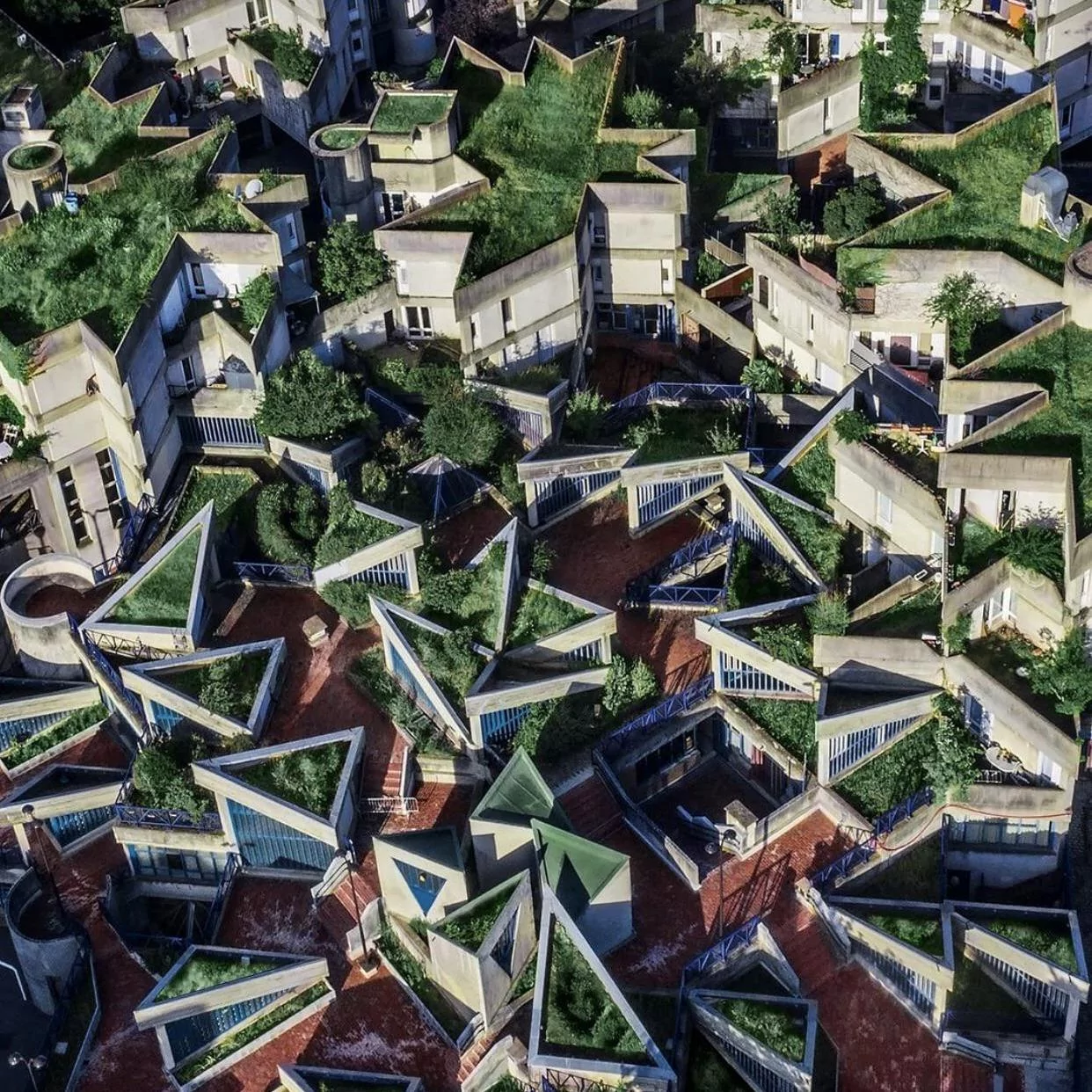
In the 1960s, the municipality decided to rebuild its city center by demolishing existing housing. Renée Gailhoustet, chief architect of the project, experimented with Jean Renaudie on an alternative concept for social housing that stood in opposition to the standardization typical of large-scale public housing developments. Constructed between 1969 and 1975, this complex was the city's final major residential undertaking, following the Raspail and Lenin towers as well as the Casanova estate.
The principle is geometric: triangular concrete points grafted onto an orthogonal grid radiate in all directions—hence the name. No apartment resembles its predecessor; each is an irregular figure extended by ground-level terraces planted with vegetation, turning the façade into a vegetated relief and breaking down the opposition between high-rise building and detached house. The vocabulary belongs to brutalism: exposed concrete and angular volumes—but employed here not for repetition but to differentiate the dwellings.
The complex goes beyond housing: the adjacent Jeanne-Hachette center superimposes residences, cultural facilities, shops, and pedestrian pathways within a single mass, embodying the concept of a complete stacked city. The apartments were sold via access-to-ownership schemes, distinguishing this project from most social programs of its time. Renaudie lived there until her death in 1981. Today, the complex is severely deteriorated, with the shopping center housing only a few shops.
All exhibitions and places in and around Paris on Groom