Église Notre-Dame-du-Travail
Paris
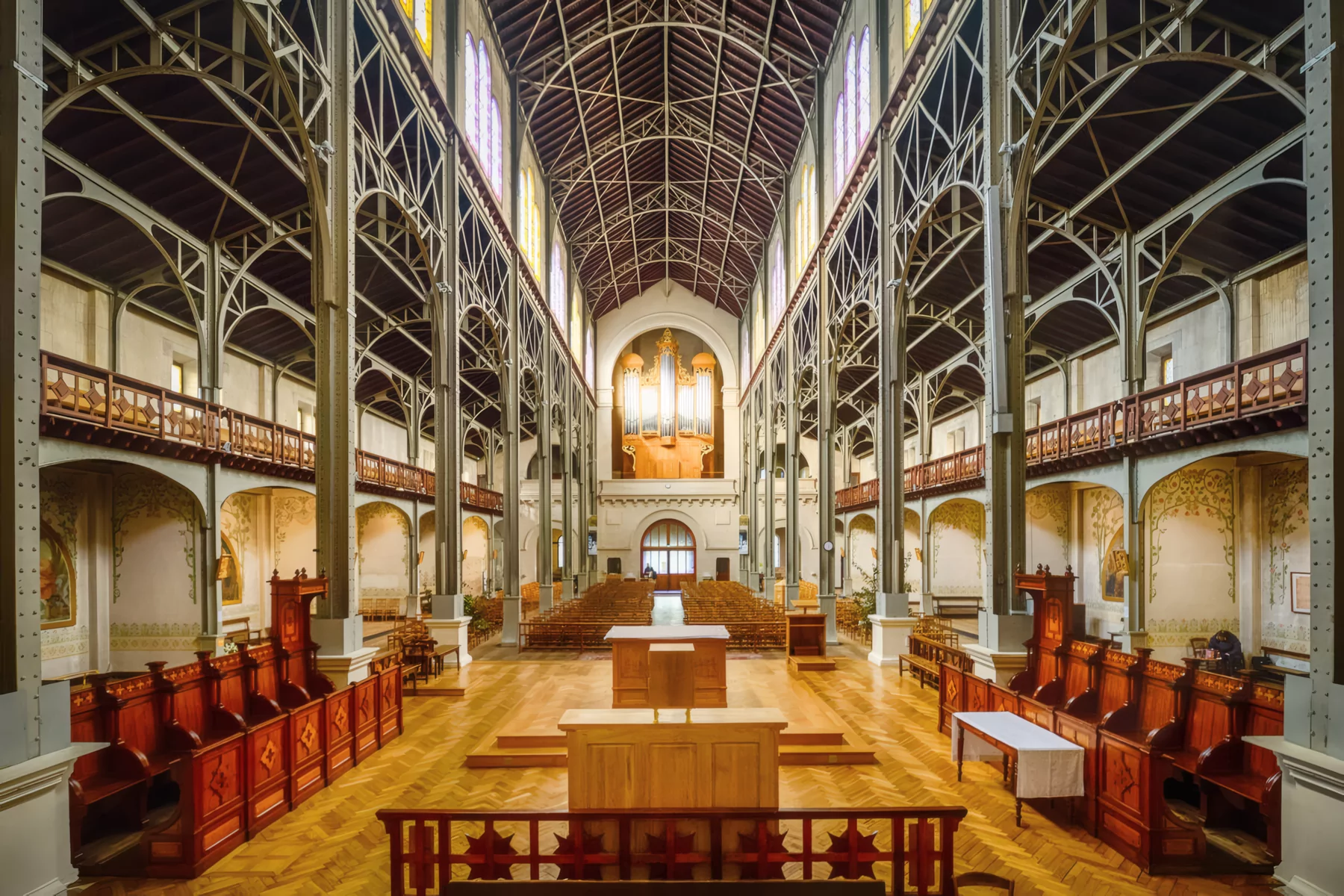
Abbé Roger Soulange-Bodin launched the project and fundraising campaign in 1897 with the ambition of replacing a church in Plaisance that had become too small, and creating a place for workers to gather—ready to welcome visitors from the 1900 Universal Exposition. The building pays tribute to the working-class condition in an area populated by laborers tasked with assembling the universal exhibitions. Subscription appeals, including one print run of 100,000 copies now preserved at the Archbishop's archives, explain why a faubourg devoid of any church was chosen for its 35,000 inhabitants.
The main innovation of Jules-Godefroy Astruc's (1862–1955) project lies in its metal framework, which fulfills the function of traditional arches and columns inside—visible rather than concealed—a first for a church. The inspiration comes from the Eiffel Tower, completed in 1889; Astruc was also a student of Victor Laloux, architect of the Gare d'Orsay. Absent from the original 1897 project, this choice is explained primarily by its lower cost compared to traditional construction. The timber structure reuses elements from the Palais de l'Industrie, built for the Universal Exhibition of 1855. Art Nouveau murals adorn the side chapels to soften this industrial architecture, while the façade, made in Roman-style dressed stone, reveals nothing of what lies within.
The organ, built by the Haerpfer workshop in 1991, features two distinct composition consoles: one is a fixed console with mechanical transmission for the choir loft, and the other is a mobile console equipped with electric transmission. The Stations of the Cross, installed in 1994, are the work of sculptor Christine Audin: fourteen monoxyle wood bas-reliefs without numbering; their order follows decreasing character count—from fourteen figures at the first station down to Christ alone at the final one.
All exhibitions and places in and around Paris on Groom